
How Long Does a Food Allergy Rash Last in Babies?
The rash appeared an hour after lunch, and now it's 9pm and you're trying to decide whether to keep watching or start worrying. Duration turns out to be one of the most genuinely useful clues here — not just how the rash looks, but how long it takes to fade, because different causes follow different clocks.

Fast Reactions: Hours, Not Days
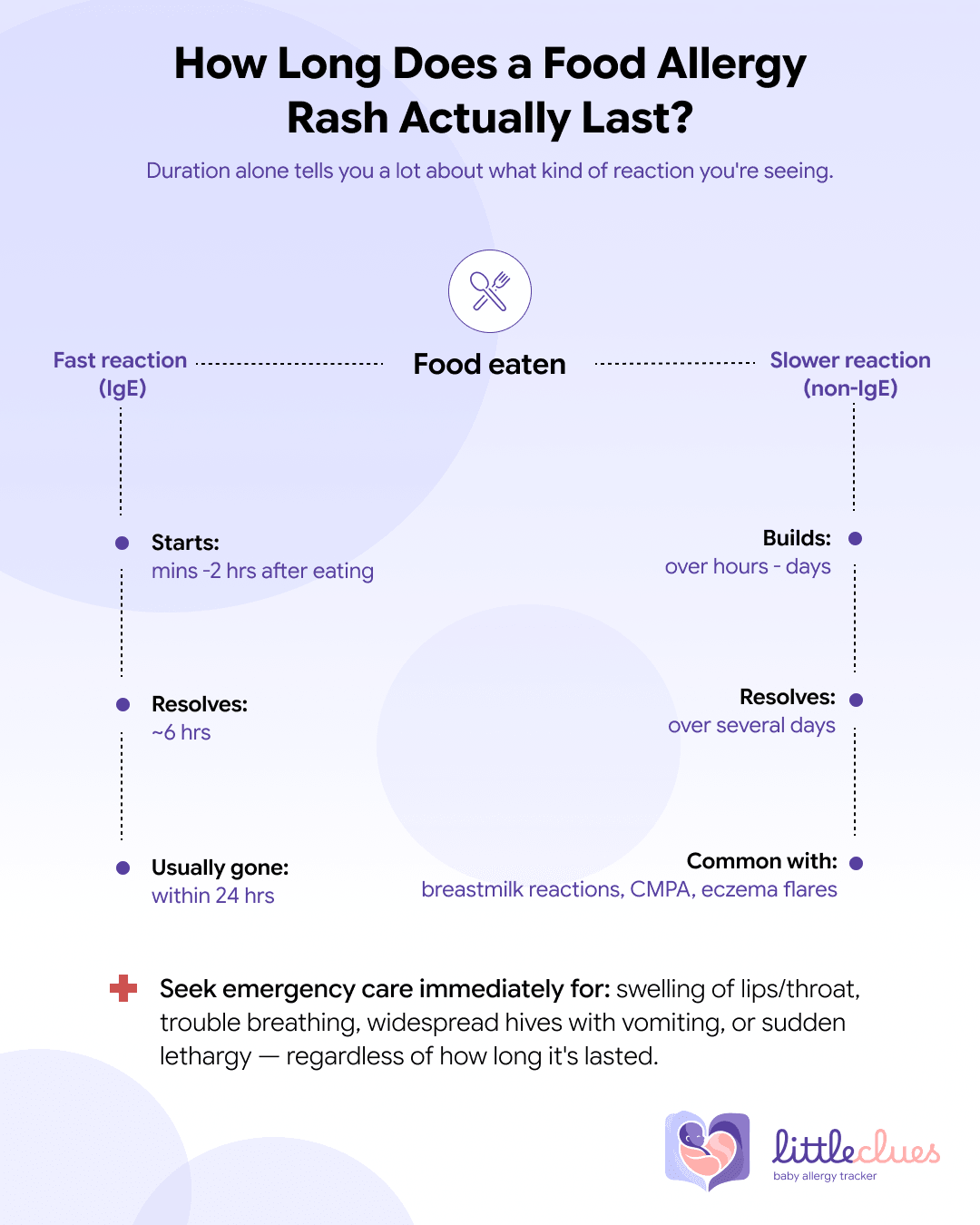
If the rash is true hives from a food allergy — the fast, IgE-mediated type — it typically starts within minutes to two hours of eating the trigger, and food-triggered hives commonly settle within about 6 hours (Raising Children Network). A single hive itself usually clears within 24 hours, even if the overall flare involves new ones replacing old ones for a bit longer (Cleveland Clinic). If it's mostly resolved by the next morning, that timeline fits a typical fast allergic reaction.
Slower Reactions: Days, Not Hours
Not every food-related rash follows that fast timeline. Non-IgE-mediated reactions — the type most often behind reactions in exclusively breastfed babies, and behind a lot of CMPA in the first year — build up gradually and can take days to fully develop or fade, rather than resolving overnight. Eczema flares linked to a food trigger often follow this slower pattern too: worsening over several days of continued exposure, rather than appearing and clearing within a single evening.
This is exactly the distinction covered in more depth in how food reaches a breastfed baby through breast milk and in CMPA symptom timelines — the "how long did it take to show up" question and the "how long does it take to go away" question tend to follow the same broad pattern for a given baby.
When Duration Itself Is a Red Flag
Hives lasting more than six weeks move into a different category — chronic urticaria — and are worth discussing with a GP, since ongoing hives that long are less likely to be a single food reaction and more likely to need a different kind of investigation (Cleveland Clinic). On the other end, anything involving swelling of the face or throat, difficulty breathing, vomiting alongside widespread hives, or sudden lethargy needs emergency care immediately — duration doesn't matter at that point, get help straight away.
Why Duration Alone Isn't the Whole Answer
A rash that clears in six hours and a rash that takes four days to fade aren't just "the same thing at different speeds" — they usually point to genuinely different mechanisms, which is part of why a doctor will ask not just "what did the rash look like" but "how long did it take to show up, and how long did it take to go." Being able to answer both, with real times rather than a rough impression, is what turns "it seemed to last a while" into something a GP can actually use.
These observations are based only on patterns in your own log. They are not medical advice — always check with a healthcare professional about any rash lasting longer than expected, and seek emergency care for any signs of a severe reaction.
Turning This Into a Record You Can Use
Whatever's behind your baby's symptoms, the thing that identifies it is the same: a written record of what was eaten and what happened, with times attached. Memory doesn't hold up across three days of this — and "I think it's dairy" isn't something a GP can act on. A log is.
On paper: A free printable food and symptom diary - one version for breastfeeding, which tracks your food and your baby's side by side, and one for formula and solids. One page per day, print at home, no signup and no email.
→ Get the free printable diary
In the app: LittleClues does the same thing with the timing built in: foods and symptoms logged on their own separate timelines, with the app ranking which foods are most likely behind the reactions. Free on iOS and Android.
Frequently Asked Questions
How long does a food allergy rash usually last in a baby?
Fast, IgE-mediated hives from a food allergy typically resolve within about 6 hours, with any single hive clearing within 24 hours. Slower, non-IgE reactions and eczema flares linked to food can take several days to build and fade instead.
Is it normal for a baby's rash to last several days?
It can be, particularly for non-IgE-mediated reactions or eczema flares, which tend to build gradually and resolve more slowly than fast allergic hives. If a rash is still worsening after several days, or hasn't started improving, it's worth checking with a GP.
When does a rash duration count as an emergency?
Duration isn't the deciding factor for an emergency — sudden swelling of the face or throat, difficulty breathing, vomiting with widespread hives, or unusual lethargy need urgent care (999 or A&E) regardless of how long the rash has been present.
What does it mean if hives last more than six weeks?
That's classified as chronic urticaria, a different category from a typical single food reaction, and worth discussing with a GP for further investigation rather than continuing to watch and wait.
Does a faster-resolving rash mean it's less serious?
Not necessarily — a fast-resolving rash can still indicate a real food allergy worth investigating properly. Speed of resolution is a clue about the type of reaction (fast IgE-mediated vs. slower non-IgE), not a measure of how seriously to take it.