
How to Tell If Baby Is Reacting to Foods Through Breast Milk
Your baby hasn't started solids yet. They've never had a bottle, never tasted a purée, never touched anything but breast milk — and yet something is clearly setting off a rash, or gas, or a restless, uncomfortable few days. If you're breastfeeding, the confusing truth is that your baby doesn't need to eat a food directly to react to it. They can react to what you ate.
Here's how that actually works, what it looks like, and how to figure out whether it's happening to your baby.

How Food You Eat Reaches Your Baby
When you eat something, your body breaks it down — but small protein fragments from certain foods can pass into your breast milk within a few hours of eating. For most babies, this is completely unremarkable; it's part of how breast milk exposes a developing immune system to the outside world. For a baby with a developing sensitivity to one specific protein, though, even that small transferred amount can be enough to trigger a real reaction.
This is different from an allergy to something the baby eats directly, which is why it so often gets missed. Parents naturally scan their baby's own diet for the cause first, and a fully breastfed baby doesn't have one yet.
The Foods Most Likely to Cause a Reaction
A handful of foods account for the large majority of reactions passed through breast milk:
- Dairy — by far the most common, since cow's milk protein transfers readily and shows up in far more foods than just a glass of milk
- Soya — often overlaps with dairy sensitivity, since soya shows up in many of the same processed foods
- Egg
- Wheat
- Tree nuts and peanuts, less commonly, but worth ruling out if the pattern doesn't resolve after cutting dairy and soya
Symptoms to Watch For
Reactions passed through breast milk tend to be gradual rather than dramatic, since the amount of protein reaching your baby is small compared with eating the food directly:
- Skin: eczema flares, rash, or hives
- Digestive: excessive gas, reflux, mucus or streaks of blood in stools, loose or unusually frequent stools, colic-like fussiness after feeds
- General: unsettled sleep, ongoing fussiness that doesn't fit a "just a fussy baby" explanation, in more significant cases poor weight gain
Sudden, severe reactions — widespread hives, swelling of the face or lips, difficulty breathing — are rare with breast-milk-transferred proteins but are a medical emergency if they happen. Seek urgent medical help immediately if you see any of these.
The Timeline: How Long After You Eat?
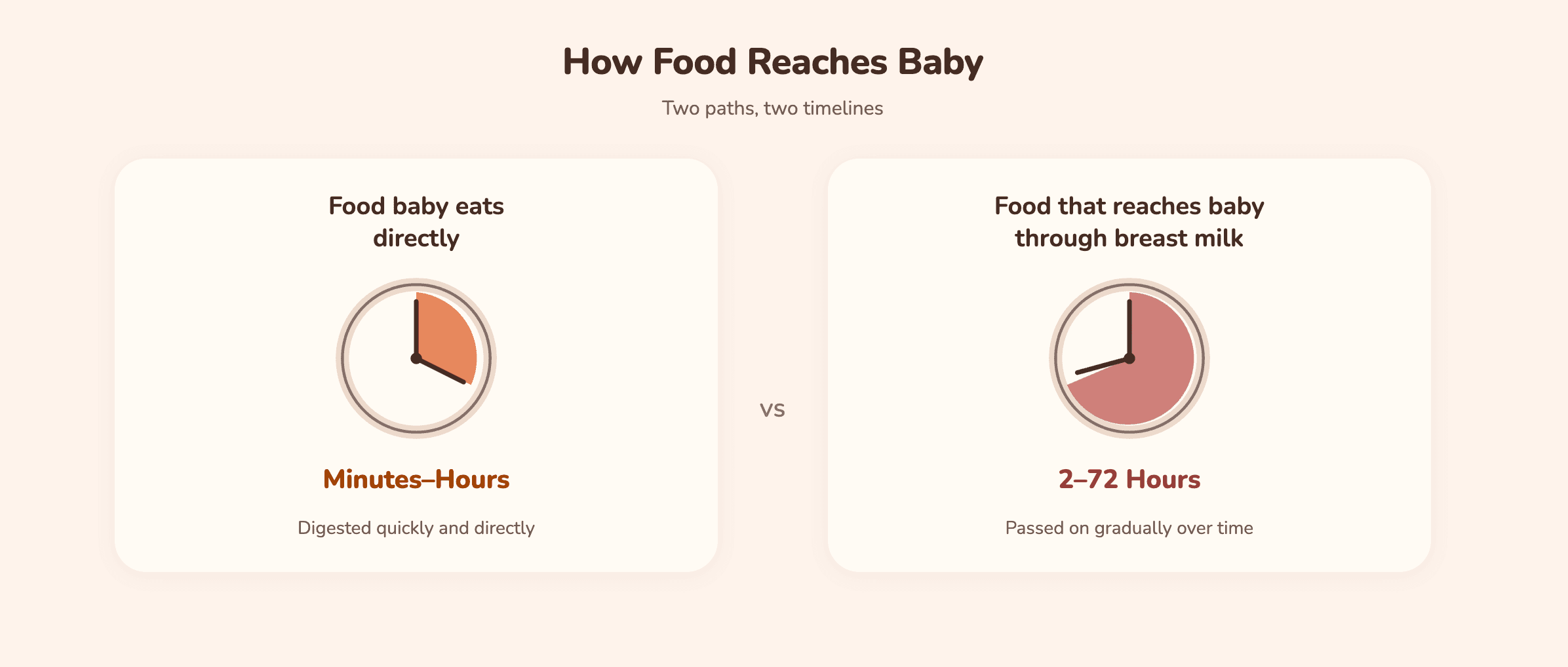
This is the part that trips up most parents trying to figure it out by memory alone. Reactions to food transferred through breast milk typically show up somewhere between 2 and 72 hours after you eat the trigger food, depending on the food and the type of reaction. Skin and digestive symptoms in particular can also build up gradually over several days of repeated exposure, rather than tracing back to one identifiable meal.
Because most trigger foods, dairy especially, get eaten multiple times across any given three-day window, pinning the exact culprit down from memory is genuinely difficult. This is the single biggest reason a "we just stopped eating X and it got better" observation, while a reasonable starting point, often turns out to be wrong on closer tracking.
How This Differs Once Solids Start
Once your baby starts eating solid food directly, you're managing two separate timelines at once: their own direct reactions, which tend to show up faster (minutes to a few hours for immediate-type reactions, though delayed reactions exist here too), and reactions to what's still passing through your milk, which follow the slower 2–72 hour window above. Treating these as one undifferentiated pool of "food and symptoms" makes the pattern much harder to see than tracking them on their own separate timescales.
Tracking Makes the Difference
The useful evidence here isn't "I think it's dairy." It's a log of what you ate, when, alongside what your baby's symptoms were and when they appeared — kept separately from anything your baby eats directly once solids begin. That's what turns a hunch into something a GP or health visitor can actually act on.
These observations are based only on patterns in your own log. They are not medical advice — always check with a healthcare professional about suspected food reactions.
Turning This Into a Record You Can Use
Whatever's behind your baby's symptoms, the thing that identifies it is the same: a written record of what was eaten and what happened, with times attached. Memory doesn't hold up across three days of this — and "I think it's dairy" isn't something a GP can act on. A log is.
On paper: A free printable food and symptom diary - one version for breastfeeding, which tracks your food and your baby's side by side, and one for formula and solids. One page per day, print at home, no signup and no email.
→ Get the free printable diary
In the app: LittleClues does the same thing with the timing built in: foods and symptoms logged on their own separate timelines, with the app ranking which foods are most likely behind the reactions. Free on iOS and Android.
Frequently Asked Questions
Can my baby react to food I ate if they've never eaten solids?
Yes. Protein fragments from certain foods you eat can pass into your breast milk within a few hours, and for a sensitive baby that's enough to trigger a reaction even though they've never eaten the food directly.
How long after I eat does a reaction show up in my breastfed baby?
Typically somewhere between 2 and 72 hours, depending on the food and the type of reaction. Some symptoms, especially skin and digestive ones, build up gradually over several days of repeated exposure rather than tracing to one single meal.
What foods are most likely to cause a reaction through breast milk?
Dairy is by far the most common, followed by soya, egg, and wheat. Tree nuts and peanuts are less common but worth investigating if symptoms don't resolve after eliminating dairy and soya.
Do I need to stop breastfeeding if my baby is reacting to something I'm eating?
No. The standard approach is to identify and eliminate the trigger food from your own diet while continuing to breastfeed, not to stop breastfeeding altogether.
How is this different from tracking my baby's reactions once they start solids?
Food a baby eats directly tends to produce reactions on a faster timescale than food transferred through breast milk. Tracking both on their own separate timelines, rather than as one combined list, makes patterns much easier to spot.