
Hives vs. Eczema vs. Food Allergy Rash in Babies: How to Tell the Difference
A rash shows up, and the questions start immediately. Is this the eczema flaring up again, or is it something they just ate? Do we need to get to A&E, or does this settle on its own by tomorrow? The honest answer is that a lot of very different things can look similar on a baby's skin — but they behave differently enough, once you know what to look for, that you can usually tell them apart without guessing.

The Three You're Usually Choosing Between
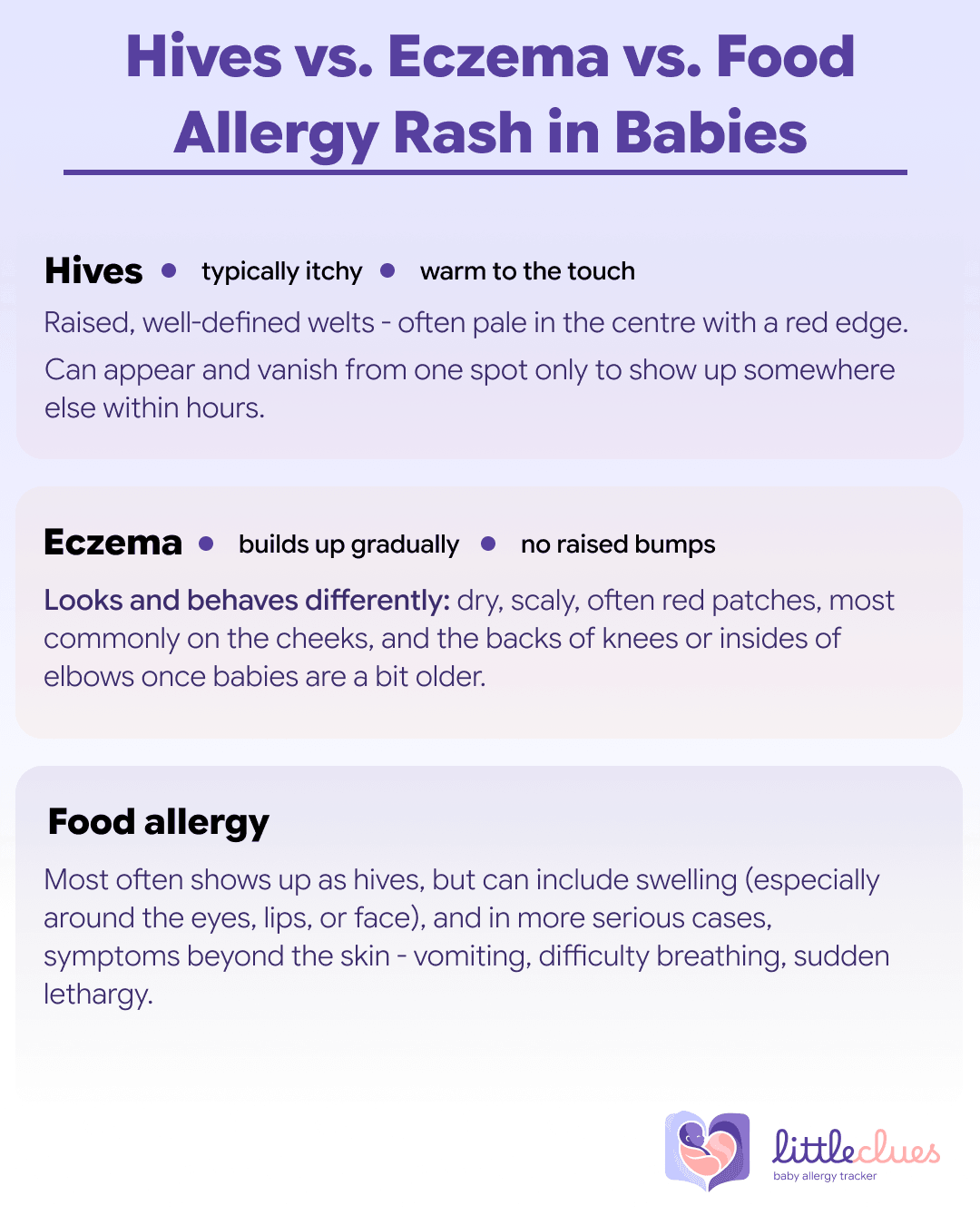
Hives (urticaria) are raised, well-defined welts — often pale in the centre with a red edge, and they can appear and vanish from one spot only to show up somewhere else within hours. They're typically itchy, warm to the touch, and — this is the key diagnostic feature — an allergic reaction "is reliable, reproducible, consistent, and timely," meaning the same food tends to trigger the same pattern each time it's eaten (Ready, Set, Food!).
Eczema (atopic dermatitis) looks and behaves differently: dry, scaly, often red patches, most commonly on the cheeks, and the backs of knees or insides of elbows once babies are a bit older. It builds up gradually over days rather than appearing suddenly, and — unlike hives — eczema itself doesn't produce raised bumps (HealthCentral).
A food allergy reaction most often shows up as hives, but can include swelling (especially around the eyes, lips, or face), and in more serious cases, symptoms beyond the skin — vomiting, difficulty breathing, sudden lethargy. Reactions typically start within minutes to two hours of eating the trigger food when they're the fast, IgE-mediated type (Medical News Today).
Speed of Onset Is the Fastest Clue
Allergic reactions tend to develop quickly — often within minutes to a couple of hours of exposure. Eczema, by contrast, tends to build gradually, sometimes over several days (babyallergyprevention.com.sg). If you can point to something eaten in the last two hours and the rash appeared right around then, that timing itself is meaningful evidence — far more useful than "it's been a rough skin week."
Where It Shows Up Matters Too
Eczema has favourite locations — cheeks in younger babies, the creases of elbows and knees as they get older. Hives and allergic reactions are far less predictable in location and can spread across large areas of the body rather than sticking to the same patches every time (babyallergyprevention.com.sg). A rash that's identical in the same two or three spots week after week reads very differently from one that shows up somewhere new each time.
How Long It Sticks Around
A single hive typically clears within 24 hours, though a flare made up of hives coming and going can last longer — food-triggered hives commonly settle within about 6 hours of the reaction starting (Cleveland Clinic; Raising Children Network). Eczema, left untreated, doesn't resolve on that kind of timeline at all — it's a chronic, flare-and-settle skin condition rather than a single reaction with a start and end point.
When It's Not a "Which One Is It" Question Anymore
Skip the differentiation entirely and get emergency help (999 or A&E) if you see swelling of the lips, tongue, or throat, difficulty breathing, sudden widespread hives with vomiting, or a baby becoming unusually floppy or unresponsive. These can be signs of a serious allergic reaction and shouldn't wait on a wait-and-see approach.
Why the Pattern Matters More Than Any Single Rash
One rash rarely tells you much on its own — eczema flares for reasons that have nothing to do with food (weather, soaps, growth spurts in skin dryness), and a single hive-like patch can be a coincidence. What actually builds a case is whether the same food reliably precedes the same kind of skin reaction, more than once, on roughly the same timeline. That's the "reproducible" part of the definition above, and it's very hard to hold in your head reliably three days after the fact.
These observations are based only on patterns in your own log. They are not medical advice — always check with a healthcare professional about any rash you're unsure of, and seek emergency care for any signs of a severe reaction.
Turning This Into a Record You Can Use
Whatever's behind your baby's symptoms, the thing that identifies it is the same: a written record of what was eaten and what happened, with times attached. Memory doesn't hold up across three days of this — and "I think it's dairy" isn't something a GP can act on. A log is.
On paper: A free printable food and symptom diary - one version for breastfeeding, which tracks your food and your baby's side by side, and one for formula and solids. One page per day, print at home, no signup and no email.
→ Get the free printable diary
In the app: LittleClues does the same thing with the timing built in: foods and symptoms logged on their own separate timelines, with the app ranking which foods are most likely behind the reactions. Free on iOS and Android.
Frequently Asked Questions
How can I tell if my baby's rash is eczema or a food allergy?
Eczema tends to build gradually over days, appears as dry scaly patches in fairly consistent locations (cheeks, elbow and knee creases), and doesn't produce raised bumps. A food allergy reaction typically appears as hives — raised, well-defined welts — within minutes to two hours of eating a trigger food, and tends to repeat with the same food each time it's eaten.
How long do hives from a food allergy usually last?
Food-triggered hives commonly resolve within around 6 hours, and any single hive typically clears within 24 hours, though a flare can involve new hives replacing old ones for a while. Hives lasting more than six weeks are considered a separate, chronic issue worth discussing with a GP.
Can a baby have both eczema and food allergies at the same time?
Yes, and it's common — the two frequently overlap, which is exactly what makes telling them apart on any given day difficult. Tracking the timing and pattern over multiple exposures, rather than judging from a single rash, is what usually clarifies which is which.
What does an allergic reaction rash look like compared to eczema?
Allergic hives are raised, often pale-centred welts with a red edge, and can move to new areas of the body over hours. Eczema is flatter, dry, and scaly, and tends to stay in the same general locations rather than migrating.
When should I take my baby to A&E for a rash?
Immediately, for any rash accompanied by swelling of the lips, tongue, or throat, difficulty breathing, sudden widespread hives with vomiting, or unusual floppiness or unresponsiveness. These can indicate a serious allergic reaction.