
FPIES in Infants: What Parents Need to Know
Two hours after trying rice cereal for the first time, your baby starts vomiting — repeatedly, forcefully, over and over. No rash. No hives. Nothing that looks like the food allergy reaction you were braced for. By the time it's over they're pale and unusually limp, and by the next day they seem completely fine. It doesn't look like a typical allergy, and standard allergy tests often come back clean, which is exactly why FPIES gets missed or misdiagnosed so often.

What FPIES Actually Is
FPIES — Food Protein-Induced Enterocolitis Syndrome — is a type of food allergy that affects the gut rather than triggering the classic skin-and-airway response most people associate with allergies. Unlike the IgE-mediated allergies behind sudden hives or swelling, FPIES is non-IgE-mediated, which means standard allergy tests (skin prick tests, IgE blood tests) usually come back negative even when a real reaction is happening. Diagnosis relies heavily on the clinical picture and history, not a lab result.
The Foods Most Likely to Trigger It
FPIES most commonly shows up when solids are introduced, typically between 4 and 7 months old, though it can also occur in formula-fed infants from birth. The most frequent triggers are:
- Cow's milk and soya — the two most common triggers overall
- Rice and oats — notably common triggers among grains, which surprises a lot of parents who expect first foods like rice cereal to be "safe"
- Egg
- Less commonly: poultry, fish, and other grains
Acute vs. Chronic FPIES
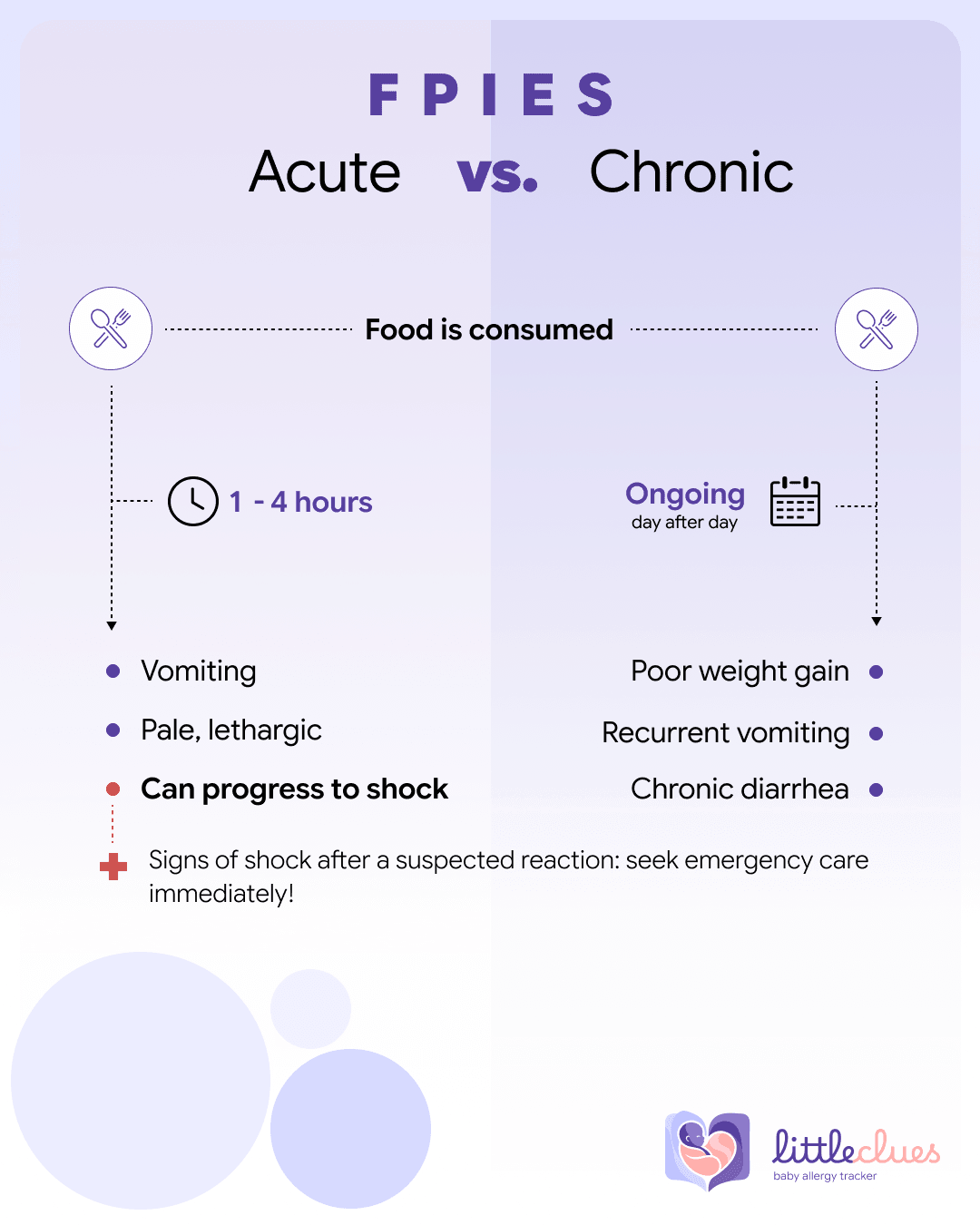
Acute FPIES is the more recognisable pattern: profuse, repetitive vomiting starting roughly 1–4 hours after eating the trigger food, often followed by pallor and lethargy. Diarrhoea can follow, typically 5–10 hours after exposure, and is sometimes bloody. In more severe episodes, a baby can become dangerously dehydrated and go into hypovolaemic shock — a medical emergency.
Chronic FPIES looks different: with regular, ongoing exposure to a trigger (most often through formula), it can cause chronic vomiting, diarrhoea, and poor weight gain without one clear, dramatic episode to point to — which makes it even easier to miss.
When to Seek Emergency Care
If your baby becomes extremely lethargic, unusually pale or floppy, or shows signs of shock — a fast heart rate, poor responsiveness, cold extremities — after a suspected FPIES episode, this is a medical emergency. Call 999 or go to your nearest A&E immediately. Don't wait to see if it resolves on its own.
How FPIES Is Diagnosed
Because standard allergy tests typically don't catch FPIES, diagnosis leans heavily on a detailed history: what was eaten, how long afterwards symptoms started, exactly what those symptoms were, and whether the pattern repeats with re-exposure. In some cases, doctors confirm the diagnosis with an oral food challenge — deliberately reintroducing the suspected food under close medical supervision, in a clinical setting with IV access available, precisely because a reaction can be severe.
This is the one point worth being very clear on: reintroducing a suspected FPIES trigger at home, on your own, is not the same process used for milder food intolerances, and isn't something to attempt without your doctor's guidance. The risk of a significant reaction on reintroduction is real.
Managing FPIES
Once a trigger is identified, management is strict avoidance of that specific food, guided by an allergist or paediatrician, with reintroduction attempted later only under medical supervision. The good news for most families: the majority of children outgrow FPIES by age 3–5, though different trigger foods (milk, soya, grains) can resolve on different timelines, which is part of why an allergist typically manages the reintroduction schedule individually rather than on a fixed calendar.
Why Tracking Matters More Here, Not Less
Because there's no simple test to confirm FPIES, the history you bring to an appointment carries more weight than it would for many other allergies. Precise timing is the whole ballgame: what was eaten, exactly when, and exactly when symptoms started and resolved. A vague "he got sick after we tried rice" is far less useful to an allergist than a log showing the food, the time, the exact symptom sequence, and whether it happened again on a later exposure.
These observations are based only on patterns in your own log. They are not medical advice — always check with a healthcare professional about suspected FPIES or any food allergy, especially before attempting any reintroduction.
Turning This Into a Record You Can Use
Whatever's behind your baby's symptoms, the thing that identifies it is the same: a written record of what was eaten and what happened, with times attached. Memory doesn't hold up across three days of this — and "I think it's dairy" isn't something a GP can act on. A log is.
On paper: A free printable food and symptom diary - one version for breastfeeding, which tracks your food and your baby's side by side, and one for formula and solids. One page per day, print at home, no signup and no email.
→ Get the free printable diary
In the app: LittleClues does the same thing with the timing built in: foods and symptoms logged on their own separate timelines, with the app ranking which foods are most likely behind the reactions. Free on iOS and Android.
Frequently Asked Questions
What is FPIES?
Food Protein-Induced Enterocolitis Syndrome is a non-IgE-mediated food allergy that affects the gut, typically causing delayed, repetitive vomiting rather than the hives or swelling associated with more familiar allergic reactions.
What foods most commonly trigger FPIES?
Cow's milk and soya are the most common triggers, followed by rice and oats, then egg. Rice and oats surprise many parents since they're often introduced as "safe" first foods.
Why do standard allergy tests miss FPIES?
FPIES is non-IgE-mediated, so it doesn't produce the antibody response that skin prick tests and IgE blood tests are designed to detect. Diagnosis relies mainly on clinical history rather than lab results.
Is it safe to reintroduce a suspected FPIES trigger food at home?
No — reintroduction of a suspected FPIES trigger should be done under medical supervision, typically as a supervised oral food challenge in a clinical setting, because the reaction on reintroduction can be severe.
Do children outgrow FPIES?
Most children outgrow FPIES by age 3–5, though the timeline can vary by trigger food, which is why reintroduction is usually managed individually by an allergist rather than on a fixed schedule.