
Elimination Diet While Breastfeeding: How to Track What's Working
Your GP or health visitor suggested cutting dairy for a couple of weeks to see if it helps your baby's symptoms. It's sound advice — and also, if you've never done it before, oddly vague. Cut it for how long, exactly? What counts as "helped"? And when do you put it back?
An elimination diet is really a two-part experiment: remove, then reintroduce. Most of the useful information comes from the second half, which is also the half most parents skip because things seem to be going well and nobody wants to rock the boat. Here's how to do both parts properly.

What an Elimination Diet Actually Is
The idea is simple: remove a suspected food from your own diet for a set period, watch whether your baby's symptoms change, then reintroduce the food deliberately and watch again. If symptoms improve on removal and come back on reintroduction, that's a real pattern — not a coincidence.
The mistake most parents make is stopping after the first half. Symptoms ease, life gets easier, and nobody wants to reintroduce a food that might bring the rash back. Understandably. But without reintroduction, you can't actually tell whether the food was the cause or whether things would have improved anyway — plenty of baby symptoms wax and wane on their own timeline, unrelated to diet.
Why Timing Matters More Than You'd Think
If you're breastfeeding, food proteins from your diet pass into your milk and can affect your baby anywhere from about 6 hours to 72 hours later, depending on the food and the baby. This delay is exactly why casual observation ("I had cheese on Tuesday and baby seemed fine that evening") is so unreliable — the reaction you're looking for might not show up until Thursday.
This is also why eliminating more than one food at a time causes problems. If you cut dairy and soy together and symptoms improve, you genuinely don't know which one — or whether it was both, or neither, and something else changed. One food at a time, with enough days on each side to see the delayed window play out, is the only way to get a clean answer.
How Long to Eliminate Before You'll Know Anything
Most paediatric guidance suggests at least 2–4 weeks fully off a suspected food before judging whether it's made a difference. Shorter than that, and you risk mistaking a good few days for a real trend. It also takes time for the food protein to clear fully from your system and stop showing up in your milk.
During this window, resist the urge to also change other things — new supplements, a new laundry detergent, a sudden batch of new baby foods. Every extra variable makes it harder to know what actually caused any change you see.
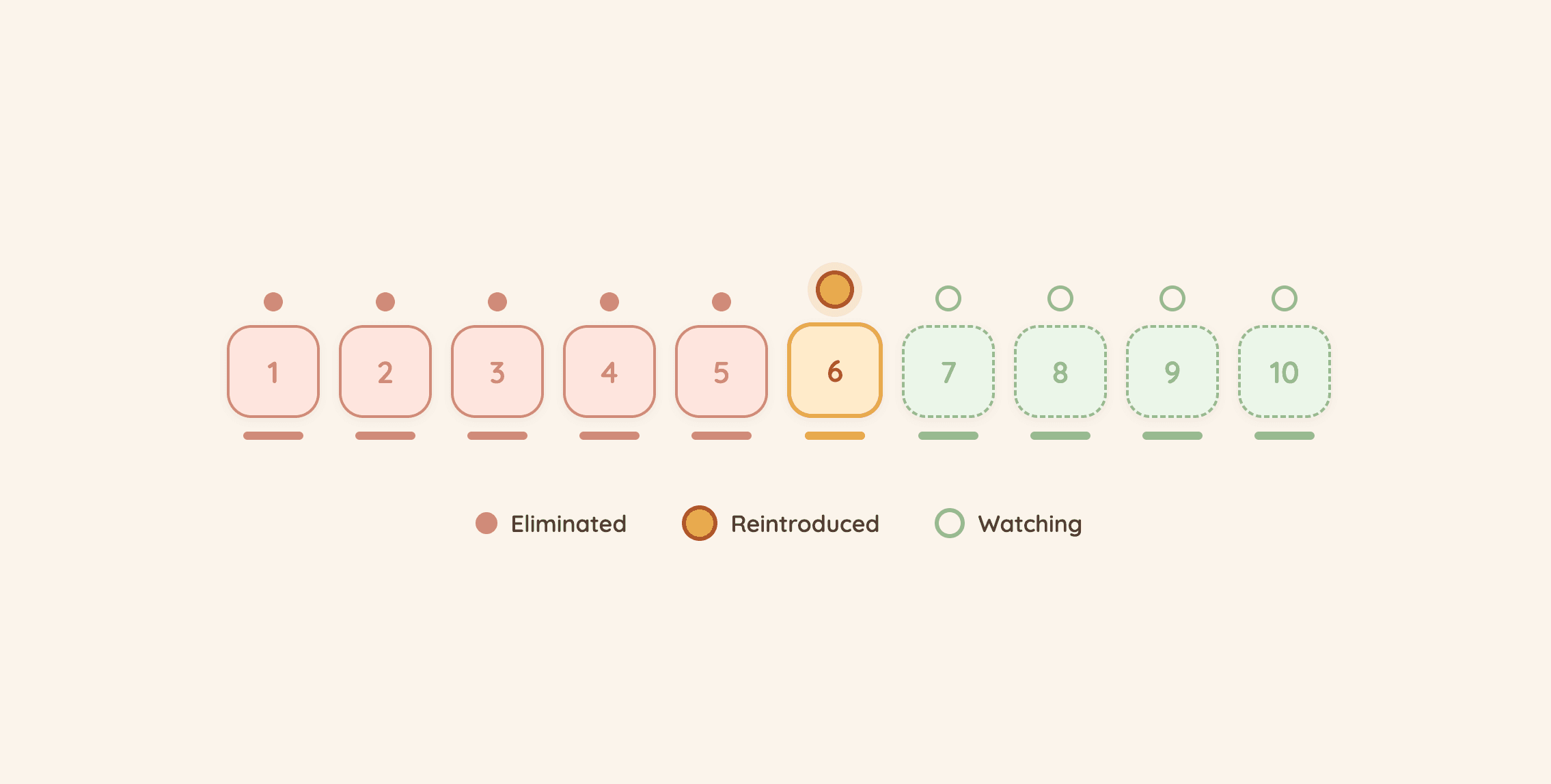
The Reintroduction Phase Is Where the Real Data Comes From
Once you've had a clear stretch without the food and symptoms have settled, reintroduce it deliberately — not by accident at a dinner party. Eat a normal-sized portion, note the exact day and time, and then watch closely for the next 72 hours. If symptoms that had eased come back within that window, that's meaningful corroboration. If nothing happens, that's meaningful too — it may not have been the trigger after all.
Some clinicians recommend doing this reintroduction more than once before fully ruling a food in or out, since a single exposure either way can be coincidence. If you can manage a second round a week or two later, the pattern becomes much more convincing one way or the other.
Nutritional Safety While You Eliminate
This is the part that gets skipped in casual advice, and it matters. Cutting dairy while breastfeeding removes a significant source of calcium and protein from your own diet — manageable with substitution, but worth doing deliberately rather than by accident. If you're eliminating more than one major food group (dairy and soy, or dairy and wheat), or eliminating for longer than a few weeks, it's worth asking your GP for a referral to a paediatric dietitian. They can make sure you're still getting what you need, and what your baby needs through your milk.
Don't attempt a broad, multi-food elimination diet on your own without guidance — it's a legitimate medical tool, not a wellness trend, and it works best with someone checking your nutrition along the way.
What to Track Throughout
Both halves of the experiment need the same kind of record: what you ate and when, and what symptoms your baby had and when — for the whole elimination period and the whole reintroduction period, not just the days you remember to write something down.
At minimum, log:
- The date you started eliminating, and the date you stopped
- What (if anything) you substituted it with
- Every day's symptoms, even "nothing today" — the food-free days are your baseline, and they matter as much as the symptom days
- The exact day and time of reintroduction, and everything that follows for at least 72 hours
These observations are based only on patterns in your own log. They are not medical advice — always check with a healthcare professional, ideally a paediatric dietitian, before starting or extending an elimination diet while breastfeeding.
Turning This Into a Record You Can Use
Whatever's behind your baby's symptoms, the thing that identifies it is the same: a written record of what was eaten and what happened, with times attached. Memory doesn't hold up across three days of this — and "I think it's dairy" isn't something a GP can act on. A log is.
On paper: A free printable food and symptom diary - one version for breastfeeding, which tracks your food and your baby's side by side, and one for formula and solids. One page per day, print at home, no signup and no email.
→ Get the free printable diary
In the app: LittleClues does the same thing with the timing built in: foods and symptoms logged on their own separate timelines, with the app ranking which foods are most likely behind the reactions. Free on iOS and Android.
Frequently Asked Questions
How long should an elimination diet last while breastfeeding?
Most guidance suggests at least 2–4 weeks fully eliminating a suspected food before judging whether symptoms have improved, followed by a deliberate reintroduction to confirm the pattern. Shorter periods make it harder to distinguish a real effect from normal day-to-day variation.
Do I need a dietitian to do an elimination diet while breastfeeding?
For eliminating a single common food short-term, many parents manage with GP guidance alone. If you're cutting more than one major food group, eliminating for an extended period, or feeling uncertain about your own nutrition, ask for a referral to a paediatric dietitian — they can help you substitute safely for both you and your baby.
What foods are most commonly eliminated for breastfed babies with suspected reactions?
Cow's milk (dairy) is by far the most common, followed by soy, egg, and wheat. These four account for the large majority of suspected food-related reactions investigated in breastfed infants.
How do I know if a reaction after reintroduction is real or a coincidence?
Look for symptoms reappearing within the same delayed window you saw during the original elimination period — typically within 6 to 72 hours of the reintroduced food. A single reintroduction that lines up with returning symptoms is suggestive; a second reintroduction showing the same pattern a week or two later is much stronger evidence.
Can I do an elimination diet without stopping breastfeeding?
Yes — an elimination diet changes what you eat, not whether you breastfeed. It's specifically an alternative to stopping breastfeeding, allowing you to keep nursing while identifying and removing a suspected trigger from your own diet.