
Eczema and Food Allergy in Babies: What the Research Actually Shows
If your baby has eczema, you've probably already had someone — a relative, a stranger in the supermarket, a corner of the internet at 2am — suggest it's "probably something they're eating." That's not quite right, but it's not nothing either. There's a real, well-studied relationship between eczema and food allergy, and understanding it changes what's actually worth watching for.
The Numbers, Not Just the Anecdote
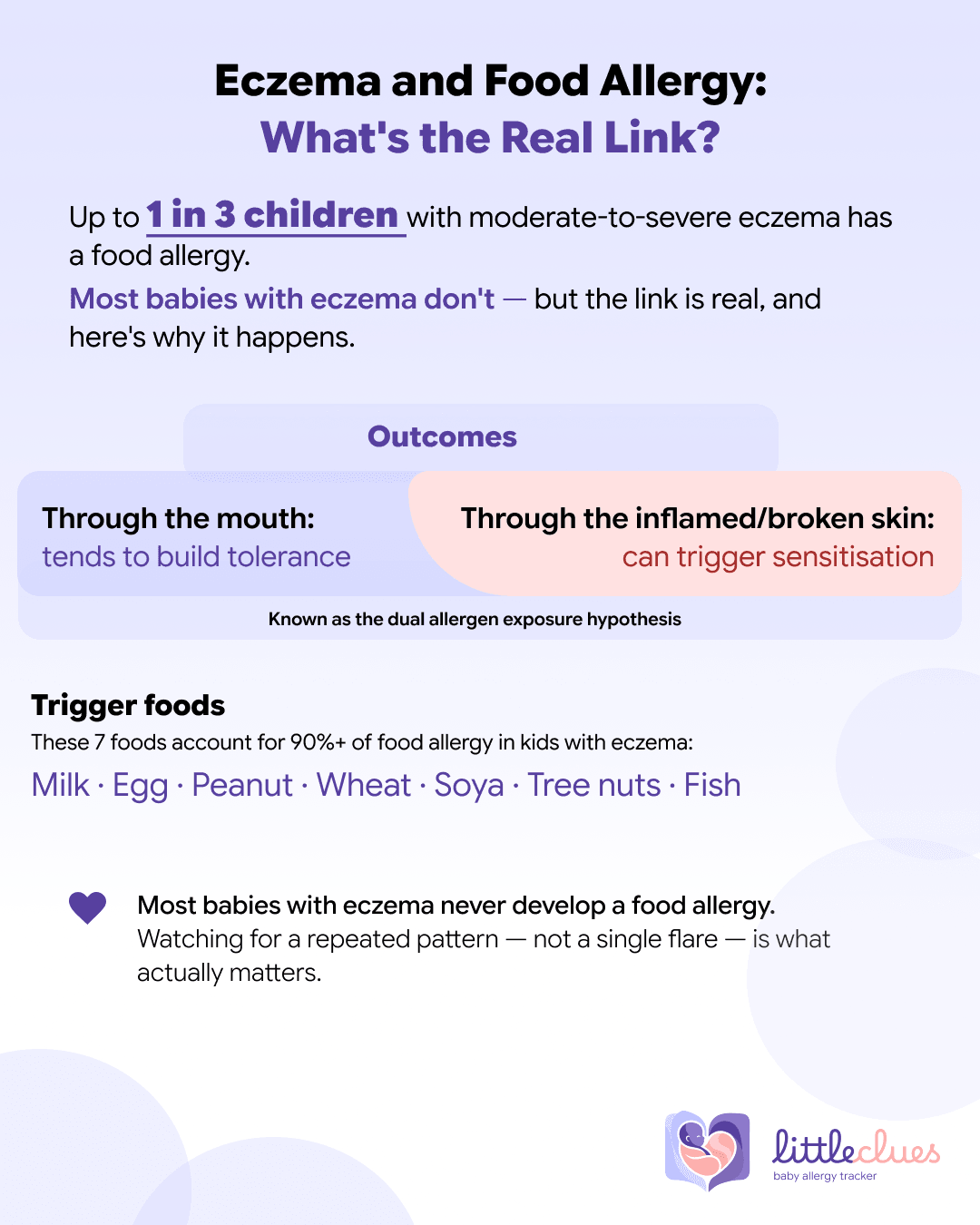
Food allergy has been documented in roughly a third of children with moderate-to-severe atopic dermatitis (eczema) — with estimates in the research ranging from about 20% to 40% depending on severity (PMC — Relationship Between Atopic Dermatitis and Food Allergy in Children). Looking at it from the eczema side specifically: up to around 30% of children under five with eczema have a diagnosed food allergy (Allergy & Asthma Network). That's a meaningful minority, not a certainty — most babies with eczema don't have a food allergy — but it's high enough that the connection is worth taking seriously rather than dismissing as folk wisdom.
The foods responsible are a short, familiar list: cow's milk, egg, peanut, wheat, soya, tree nuts, and fish account for more than 90% of food allergy in children with atopic dermatitis (PMC) — the same foods that come up again and again across CMPA, FPIES, and breast-milk-reaction tracking.
Why the Link Exists: The Skin Barrier
The leading explanation is called the dual allergen exposure hypothesis, first proposed by paediatric allergist Gideon Lack in 2008. The idea: exposure to a food allergen through the mouth, in normal amounts, tends to build tolerance. Exposure to that same allergen through broken or inflamed skin — like eczema — can do the opposite, and prime the immune system to react to it as a threat (PMC — Skin and oral intervention for food allergy prevention based on dual allergen exposure hypothesis).
In practice, this means a damaged skin barrier isn't just a symptom sitting alongside a food allergy — in a meaningful number of cases, it may be part of how the sensitisation happened in the first place. Severe eczema, and even allergen residue in skincare products, have been linked in research to a higher risk of developing a food allergy to that specific allergen later (PMC).
What This Means for Managing Eczema Itself
One of the practical implications researchers point to is that treating eczema well — keeping the skin barrier as intact and well-moisturised as possible — isn't just about comfort. It's now understood as one half of a two-part prevention approach, alongside appropriately timed introduction of allergenic foods by mouth, rather than avoidance (PMC). This is part of why current guidance has moved away from delaying allergenic foods "just in case," particularly for babies with eczema — the research points the other way.
So Does Eczema Mean a Food Allergy Is Coming?
No — and this is worth sitting with, because it's easy to read the statistics above and start expecting a reaction. Most babies with eczema, even moderate eczema, don't go on to develop a food allergy. What the research actually supports is a slightly different, more useful takeaway: if your baby has eczema, it's worth watching a bit more closely than average for a pattern between specific foods and skin or gut symptoms — not assuming a connection, and not ruling one out either.
Watching for the Pattern, Not the Single Flare
Because eczema already flares for reasons that have nothing to do with food — weather, soaps, growth, unrelated irritation — a single bad skin day after a new food tells you very little on its own. What's actually informative is whether a specific food shows up repeatedly before flares worsen, tracked alongside the food your baby (or you, if breastfeeding) is eating day to day.
These observations are based only on patterns in your own log. They are not medical advice — always check with a healthcare professional, ideally a paediatric allergist or dermatologist, about your baby's eczema and any suspected food allergy link.
Turning This Into a Record You Can Use
Whatever's behind your baby's symptoms, the thing that identifies it is the same: a written record of what was eaten and what happened, with times attached. Memory doesn't hold up across three days of this — and "I think it's dairy" isn't something a GP can act on. A log is.
On paper: A free printable food and symptom diary - one version for breastfeeding, which tracks your food and your baby's side by side, and one for formula and solids. One page per day, print at home, no signup and no email.
→ Get the free printable diary
In the app: LittleClues does the same thing with the timing built in: foods and symptoms logged on their own separate timelines, with the app ranking which foods are most likely behind the reactions. Free on iOS and Android.
Frequently Asked Questions
Does having eczema mean my baby has a food allergy?
No. Most babies with eczema don't have a food allergy. But research shows a real association — food allergy is documented in roughly 20–40% of children with moderate-to-severe eczema, so it's worth watching for a pattern rather than assuming or ruling it out.
Why are eczema and food allergy linked?
The leading explanation is the dual allergen exposure hypothesis: allergen exposure through inflamed or broken skin (as in eczema) can prime the immune system to react to that allergen, while exposure through eating tends to build tolerance instead. A damaged skin barrier may be part of how some food sensitisations develop.
Which foods are most linked to eczema-related food allergy?
Cow's milk, egg, peanut, wheat, soya, tree nuts, and fish account for more than 90% of food allergy cases in children with atopic dermatitis — the same handful of foods most commonly investigated in CMPA and FPIES.
Does treating eczema help prevent food allergy?
Current research treats good eczema management (keeping the skin barrier intact and moisturised) as one part of a two-part prevention approach, alongside timely introduction of allergenic foods by mouth — not avoidance of those foods.
How do I know if my baby's eczema is related to a specific food?
Look for a repeated pattern — the same food showing up before flares worsen, more than once — rather than judging from a single bad skin day, since eczema flares for many reasons unrelated to diet.