
How to Track Baby Food Allergies: A Step-by-Step Guide
You introduced oat porridge on Monday. By Wednesday your baby had a rash. But they also had banana on Tuesday, and they'd been a bit sniffly all week. Was it the oats? The banana? A cold? Something you ate if you're breastfeeding?
This is the maddening reality of baby food reactions. Nothing happens in isolation, symptoms are delayed, and your memory of what happened when gets fuzzy fast. A log fixes that — but only if you build it right from the start.
Here's how.

Step 1: Start Before You Think You Need To
Most parents start tracking after a scary reaction. That's understandable, but it means you're missing the baseline — the data from before the reaction that would tell you how often symptoms happen anyway.
If your baby gets a rash on a day when they haven't eaten anything new, that's important information. It could mean rashes are part of their background noise, not necessarily triggered by food. Without that earlier data, every rash looks like a food reaction.
Start logging now, even if things seem fine. Even a few weeks of baseline data makes the pattern-spotting dramatically more reliable later.
Step 2: Log Both Sides — Food and Symptoms
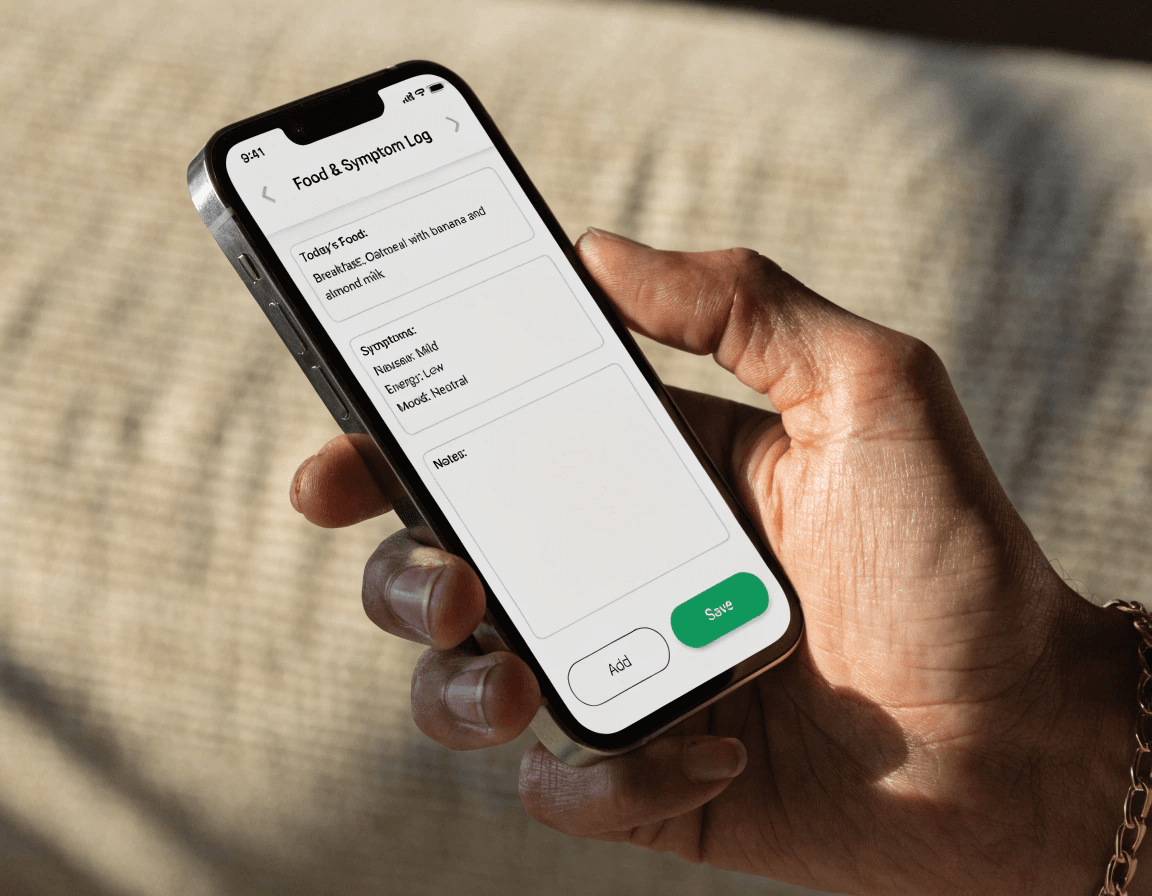
A food diary that only tracks what your baby ate is only half the picture. You need both sides: what they ate, and how they felt.
For food entries, note:
- What they ate (be specific — "yoghurt" is less useful than "full-fat cow's milk yoghurt")
- Roughly when they ate it
- Whether it was eaten directly or, if you're breastfeeding, whether you ate it
For symptom entries, note:
- What the symptom was (rash, hives, vomiting, diarrhoea, eczema flare, unusual fussiness)
- When it appeared
- How bad it was — a simple 1 to 5 scale works well
The timing between food and symptom is often what reveals the trigger. Some reactions show up within an hour. Others, especially in breastfed babies reacting to something in your diet, can take 24 to 72 hours.
Step 3: Don't Rely on Memory
The most common tracking mistake is keeping a mental note and meaning to write it down later. By the next day, you've forgotten whether the rash appeared before or after dinner, and whether it was dinner on Tuesday or Wednesday.
Log entries in the moment, or as close to it as possible. A phone app works better than a notebook for this — it's always in your pocket, and it timestamps entries automatically.
Step 4: Give Each Food Enough Exposures
One reaction after one exposure doesn't confirm a trigger. Babies have good days and bad days. A rash that appeared the same afternoon as a new food could be a coincidence — especially if it was mild and cleared quickly.
Try to give each new food at least three to four separate exposures before drawing conclusions, unless the reaction is severe (in which case, stop and contact your doctor immediately). A log makes this easy: you can look back and see that oats have been eaten six times, with symptoms following four of those times. That's a meaningful pattern. One time out of one is not.
Step 5: Watch for Hidden Sources
Once you're logging carefully, you'll start noticing things you hadn't considered. A food can show up in unexpected places — cow's milk in bread, egg in sauces, soy in things labelled as "dairy-free." Composite dishes are particularly tricky: if your baby reacted to a pasta bake, the log needs to capture that the pasta bake contained butter, cheese, and tomato — not just "pasta bake."
If you can, log the individual ingredients of mixed meals separately. It takes a bit more effort but it's the only way to know whether the reaction is to the pasta, the butter, or something else entirely.
Step 6: Look for Patterns, Not Proof
A food diary isn't a diagnostic test. It can't confirm a food allergy — only an allergist can do that. What it can do is surface patterns worth discussing with your doctor: foods that consistently appear before reactions, symptoms that ease during periods when a food is removed, reactions that seem to cluster around certain meals.
That information is genuinely useful to a clinician. It turns a vague "I think it might be dairy" into "dairy was consumed before 7 of the 9 reaction episodes logged over the past 6 weeks."
These observations are based only on patterns in your own log. They are not medical advice — always check with a healthcare professional about suspected allergies.
Turning This Into a Record You Can Use
Whatever's behind your baby's symptoms, the thing that identifies it is the same: a written record of what was eaten and what happened, with times attached. Memory doesn't hold up across three days of this — and "I think it's dairy" isn't something a GP can act on. A log is.
On paper: A free printable food and symptom diary - one version for breastfeeding, which tracks your food and your baby's side by side, and one for formula and solids. One page per day, print at home, no signup and no email.
→ Get the free printable diary
In the app: LittleClues does the same thing with the timing built in: foods and symptoms logged on their own separate timelines, with the app ranking which foods are most likely behind the reactions. Free on iOS and Android.
Frequently Asked Questions
How do I start tracking my baby's food allergies?
Start a log that records both food entries and symptom entries on the same timeline. Note what your baby ate, when, and how they felt afterwards. Include the severity of any symptoms on a simple 1–5 scale. Logging in an app makes timestamping automatic and keeps everything in one place.
How long does it take to identify a food allergy trigger in babies?
It typically takes 4–8 weeks of consistent logging to see clear patterns, assuming you're exposing your baby to a variety of foods. Some triggers become obvious sooner if a food consistently causes symptoms within a few hours of eating.
Can I track food allergies in a breastfed baby?
Yes. In breastfed babies, reactions can come from foods you ate that passed through breast milk — typically showing up 24 to 72 hours after your meal. A good log tracks both your diet and your baby's symptoms separately, with different time windows for each.
What symptoms should I log?
Common ones include: skin rashes or hives, eczema flares, vomiting, diarrhoea, excessive gas, mucus in stools, unusual fussiness or crying, and nasal congestion. Track anything that seems out of the ordinary for your baby.
Is a food diary enough to diagnose a food allergy?
No. A food diary can help you identify patterns and give your doctor useful information, but only a healthcare professional — typically a paediatric allergist — can diagnose a food allergy through skin tests or blood tests.