
Food Allergy vs. Food Intolerance in Babies: What's the Difference?
"I think my baby has a dairy allergy." It's one of the most common things new parents say. But what they often mean — without realising it — might be a dairy intolerance. Or a sensitivity. Or cow's milk protein allergy. These terms get used interchangeably, but they describe different things, and the distinction matters for how you track symptoms and what you do next.
Here's a plain-language breakdown.
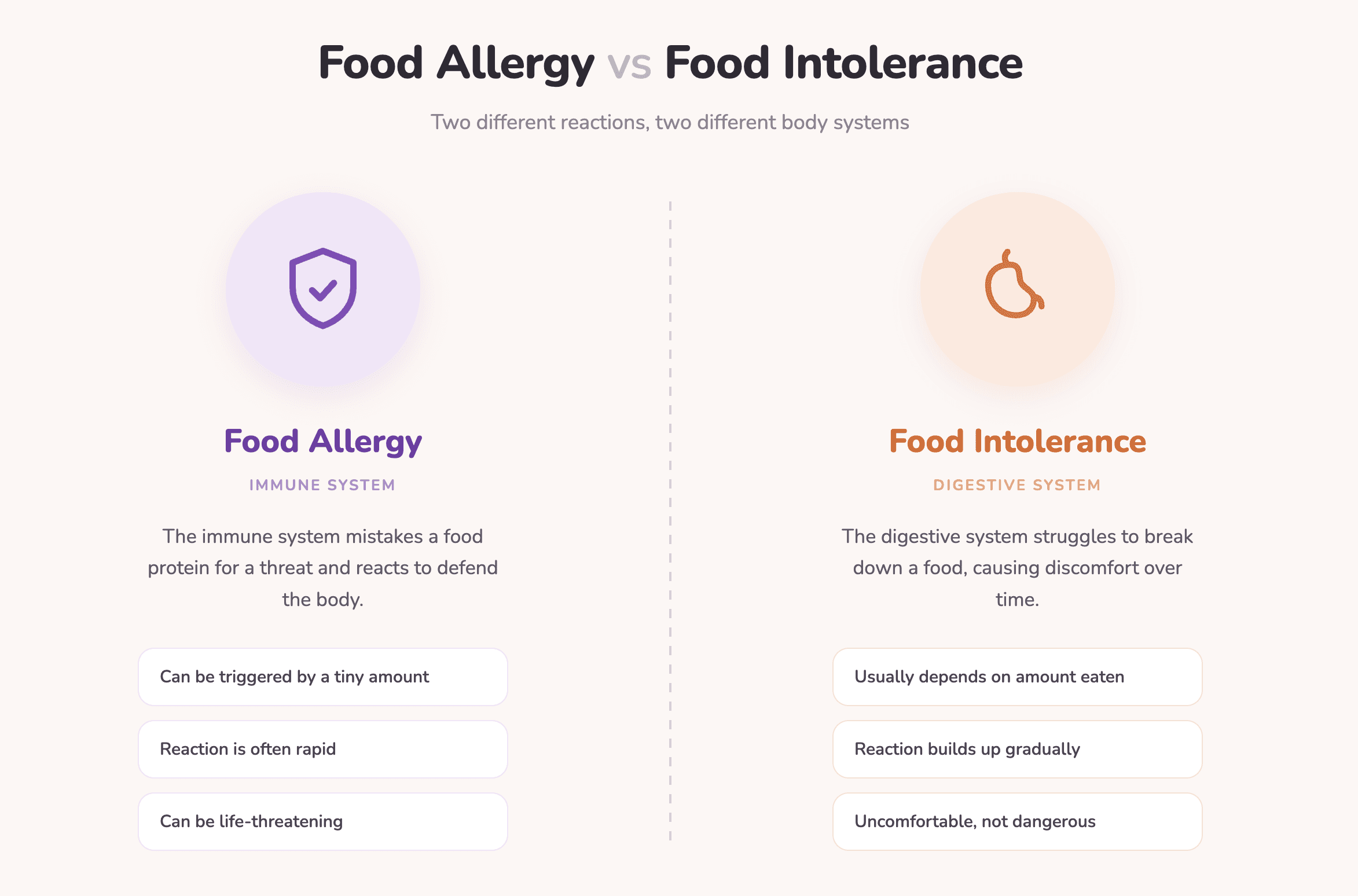
Food Allergy: An Immune System Response
A food allergy is when the immune system mistakenly identifies a food protein as a threat and launches a response against it. This can happen very quickly — sometimes within minutes of eating — and in severe cases can be dangerous.
The immune response can show up as:
- Hives or skin rashes
- Swelling of the lips, tongue, or throat
- Vomiting or diarrhoea
- Runny nose, sneezing, or watery eyes
- In severe cases, anaphylaxis (a whole-body reaction that requires emergency treatment)
The classic image of a food allergy is immediate — baby eats peanut, baby gets hives within 20 minutes. But not all allergic reactions are that fast. A condition called CMPA (cow's milk protein allergy) causes delayed reactions that take hours or even days to appear, which is why it's often missed or confused with something else.
How common are food allergies in babies? Around 5–8% of children under five have a food allergy. The most common allergens in infancy are cow's milk, egg, peanut, tree nuts, wheat, soy, and fish.
Food Intolerance: A Digestive Issue
Food intolerance is different. It doesn't involve the immune system. Instead, it's the gut's inability to properly break down or process a particular food component.
The most well-known example is lactose intolerance — where the body doesn't produce enough of the enzyme (lactase) needed to digest lactose, the sugar in milk. But genuine lactose intolerance in infants is actually rare. More common in babies is CMPA, which people often confuse for lactose intolerance but is actually an allergic reaction to milk protein.
Intolerance symptoms are mostly digestive:
- Bloating and gas
- Diarrhoea
- Stomach cramps
- Vomiting (less common than in allergy)
Crucially, food intolerance is generally not dangerous. Uncomfortable — sometimes very uncomfortable — but not the kind of thing that becomes a medical emergency.

Why the Distinction Matters
The practical difference comes down to two things: severity and how you manage it.
With a true allergy, even a small amount of the trigger food can cause a significant reaction. If your baby has a confirmed peanut allergy, peanut traces in a shared kitchen are a real risk. Management usually involves strict avoidance and — if reactions are severe — carrying an adrenaline auto-injector (like an EpiPen).
With an intolerance, the threshold matters more. Many people with lactose intolerance can handle small amounts of dairy without symptoms. It's about quantity, not just presence.
The other key difference is diagnosis and management. Allergies are confirmed with skin-prick tests or blood tests by an allergist. Intolerances are often diagnosed through elimination and reintroduction — removing the suspected food, seeing if symptoms improve, then reintroducing it and watching for a response. That reintroduction pattern is actually the clinical gold standard for identifying food intolerances.
What About "Food Sensitivity"?
You'll see this term a lot, particularly in the wellness space. Medically, it's not a standard diagnostic category — it sits somewhere between intolerance and allergy in terms of how people use it, and it often gets applied to delayed or vague reactions that don't fit neatly into either box.
For practical purposes: if your baby has consistent reactions to a food but skin tests come back negative and it doesn't look like a classic allergy, "sensitivity" is the word most parents end up using. The approach is the same as for intolerance — careful tracking, elimination, reintroduction under guidance.
What This Means for Tracking
Whether you're dealing with an allergy or an intolerance, consistent logging is how you build the case for what's actually happening.
The difference is in what you look for:
- With allergy, you're watching for fast reactions — symptoms that appear within a couple of hours of eating
- With intolerance, you're watching for patterns over time — symptoms that appear hours later or build up with repeated exposure
- With CMPA in a breastfed baby, you're watching for reactions in your baby that correlate with what you ate 24–72 hours earlier
All of these require a log that covers both food and symptoms, with accurate timestamps.
These observations are based only on patterns in your own log. They are not medical advice — always check with a healthcare professional about suspected allergies or intolerances.
Turning This Into a Record You Can Use
Whatever's behind your baby's symptoms, the thing that identifies it is the same: a written record of what was eaten and what happened, with times attached. Memory doesn't hold up across three days of this — and "I think it's dairy" isn't something a GP can act on. A log is.
On paper: A free printable food and symptom diary - one version for breastfeeding, which tracks your food and your baby's side by side, and one for formula and solids. One page per day, print at home, no signup and no email.
→ Get the free printable diary
In the app: LittleClues does the same thing with the timing built in: foods and symptoms logged on their own separate timelines, with the app ranking which foods are most likely behind the reactions. Free on iOS and Android.
Frequently Asked Questions
What is the difference between food allergy and food intolerance in babies?
A food allergy involves the immune system and can cause reactions ranging from hives and vomiting to severe anaphylaxis. A food intolerance is a digestive issue — the gut struggles to process a particular food — and is uncomfortable but not dangerous. Both can cause overlapping symptoms like vomiting and diarrhoea, which is why they're often confused.
What is CMPA in babies?
CMPA stands for cow's milk protein allergy. It's one of the most common food allergies in infancy, affecting around 2–3% of babies. Unlike lactose intolerance (which is rare in infants), CMPA is an immune reaction to the proteins in cow's milk. It can cause immediate reactions (hives, vomiting) or delayed reactions (eczema, reflux, mucus in stools) that take hours or days to appear.
Can a breastfed baby have a food intolerance or allergy?
Yes. Food proteins — including cow's milk protein — can pass from the mother's diet through breast milk to the baby. This means breastfed babies can react to foods they've never eaten directly. Symptoms typically appear 6 to 72 hours after the mother ate the trigger food.
How do I know if my baby has a food allergy or just sensitive skin?
Track it. Log every food your baby eats and every symptom that appears, with timing. If a skin reaction consistently appears after a specific food and clears when that food is removed, that's a pattern worth discussing with a doctor. If the rash appears and disappears unpredictably with no clear food connection, it may be eczema or another skin condition rather than an allergic response.
Can babies outgrow food allergies?
Many do. Around 80% of children with cow's milk and egg allergies outgrow them by school age. Peanut, tree nut, and shellfish allergies are more likely to persist into adulthood. An allergist can periodically re-test your child to assess whether an allergy has resolved.
What's the best way to track a baby's food allergies at home?
Use a structured log that records both what your baby eats and any symptoms that appear, with timestamps. Track the severity of symptoms on a simple scale. If you're breastfeeding, log your own meals too. Apps like LittleClues are built specifically for this and surface patterns in your log that are hard to see manually.